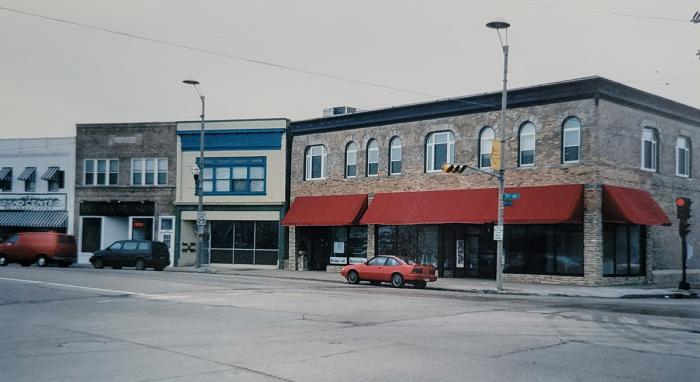
Today 5000 Seventh Avenue is the home of Olafson & Porter Vintage Goods and Heavenly Arts Studio. But it has been known as the Weiskopf block in its earliest days dating back to the 1890s, and it had become famous as a furniture store through most of the 20th century.
The earliest business that can be found on the Weiskopf block is a barber shop which opened in 1891 and operated until at least 1897. Through the next few years, Charles Skidd operated a hardware store, W.T. Hamlet had his plumbing shop, and father-and-son duo William and Edwin Lamb ran a drug store and a telegraphy school, respectively.
According to the Kenosha News from this era, “The fronts of these (storefronts) were not particularly inviting to the fastidious eye trained for harmony and beauty in architecture for a business street.”
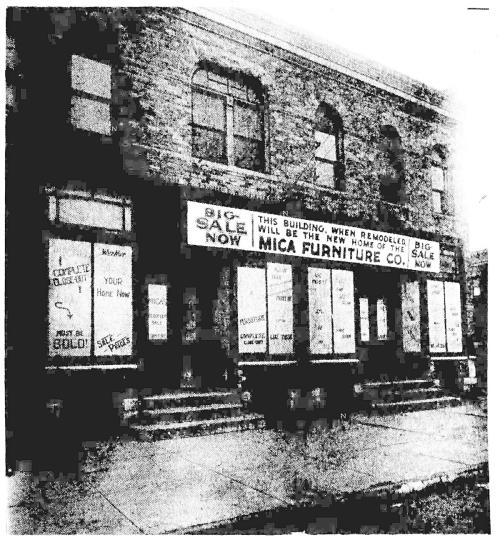
History of the Building
Anton Mica (1888-1948) was born in the town of Uhrovec (in current-day Slovakia) and came to Kenosha in 1906. By 1910 he was employed by Bode Brothers furniture store, but set his sights higher.
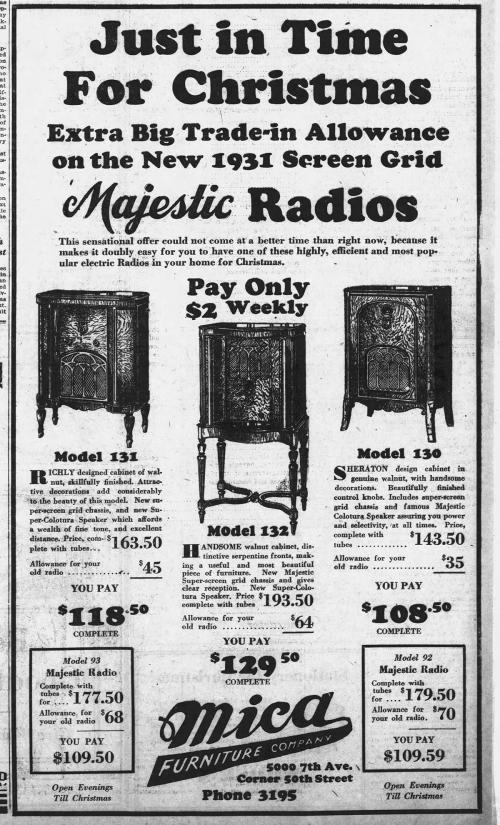
The Mica Furniture Company opened on March 27th, 1918 at 5016/20 Seventh Avenue (currently home to the Aikikai Dojo).
Soon after, Mica purchased the three storefronts from the Weiskopf estate in November of 1924 for $36,000 (over $673,000 in 2025).
The building that stood there would soon become unrecognizable.
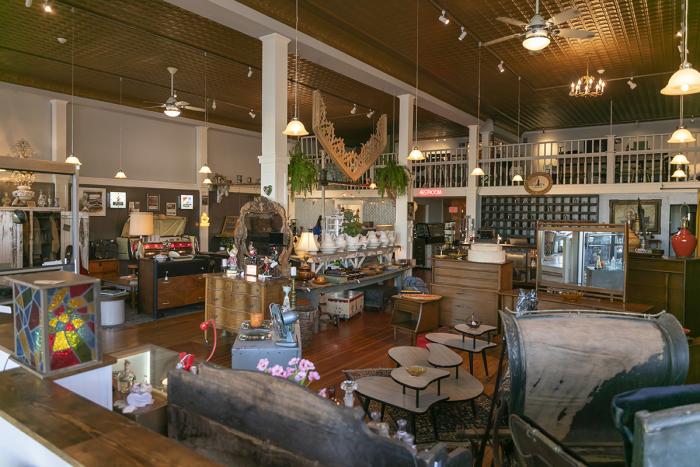
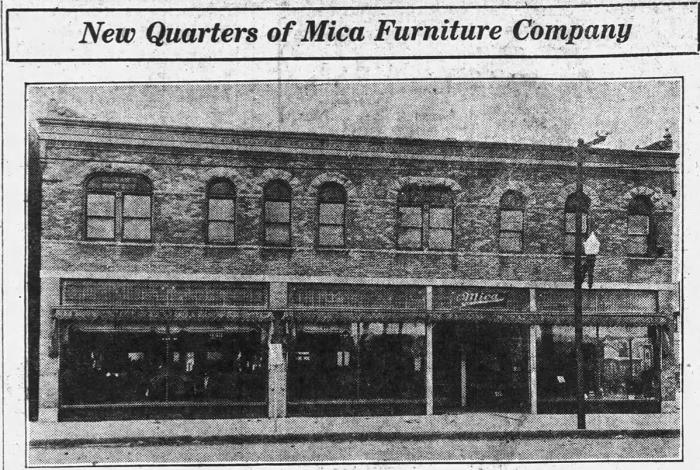
In 1925, Anton Mica was now the proud proprietor of one of the finest displays in the city. The building had been completely remodeled with new windows and interior, including a second floor and mezzanine. Mica was extremely proud that all the major work was done by Kenosha businesses, calling this new workmanship “All-Kenosha.”
Mica announced a three-day grand opening celebration which began on Thursday, March 19th, 1925.
Mica was a beloved community member. He was instrumental in the construction of St. Anthony’s church on 51st Street and 22nd Avenue, involved in numerous community groups, and was also known to belt out a song on special occasions. By the early 1930s, Mica’s health began to deteriorate and he and his wife began traveling to Arizona to spend the winters. By February 1935, his son Joseph Mica was named Vice President and manager.
Over the next few years, Anton and his wife would return to Kenosha to visit in the summers. He expressed confidence that his son was conducting the business in the same professional way he did.
After being drafted into the US Army in January 1943, Lieutenant Joseph Mica, age 33, was killed in action in Germany on March 17th, 1945. The last letter was dated March 12th to local baker Henry Platzbecker, asking him to send him some “Kenosha cookies.”
Obviously heartbroken, Anton Mica sold the family business to Frank Bobusch on September 1st, 1945. Mica remained in Tucson, Arizona for the remainder of his life and died on November 5th, 1948 at the age of 60.
The Bobusch Family
The story of Frank Bobusch follows a similar path to Mica’s. Frank V. Bobusch (1897-1981) was also born in Uhrovec. He was one of four brothers to come to Kenosha, arriving in 1909. One of his early jobs was involved in the Mica Company. In Mica’s original location, Bobusch was hired as a salesman. Although he moved on to other avenues, he remained involved with Mica, as both a stockholder and as the company’s Vice President in the late 1920s.
In 1924, he established the Bobusch Bros grocery store at the corner lot of Sheridan Road and 47th Street, most recently the home to ReVision Art Gallery. He opened the grocery with his brother Joseph (1901-1980). Brother Emil (1905-1983) would later take over running the store, which served the community before closing in 1993.
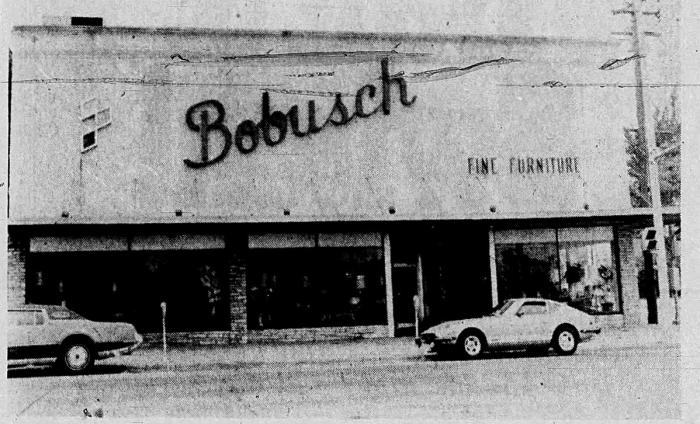
Bobusch would keep the Mica Furniture Company name for several years, even after Anton Mica passed away in 1948. Bobusch would wait until 1953 to change the name to the Bobusch Furniture Company, without celebration or fanfare.
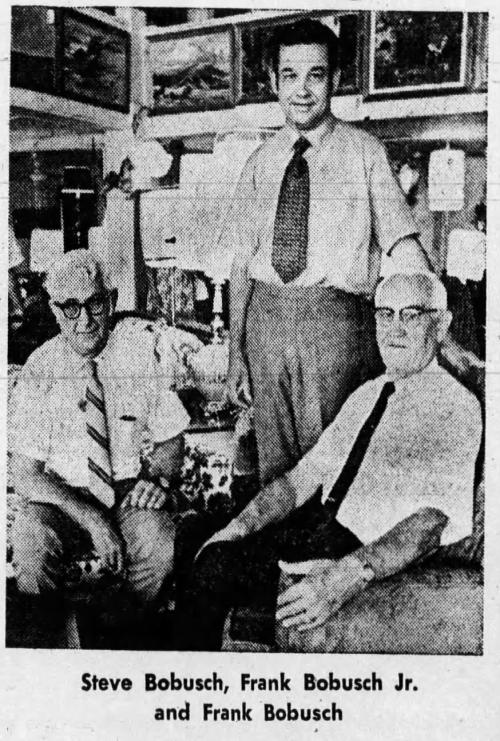
Frank’s son, Frank A. Bobusch Jr. (1928-1972) served in the U.S. Army as a veteran of the Korean conflict. After returning home, Frank Jr. would eventually become involved in the family business and as his father and uncle Steve J. Bobusch (1910-1996) aged and looked forward to retirement, Frank Jr. became president of the company in January 1968.
On Friday, June 9th, 1972, Frank Bobusch Jr. was riding with his son near New Auburn, Wisconsin, when their car collided with a truck. Frank Jr. died from injuries in the accident at age 43.
Once again, tragedy struck the owners, and once again, the old timers returned to their previous duties.
Frank Sr. and Steve, both retired at that time, reassumed responsibilities and hired Edwin J. Jacyna (1917-2004), who would soon be named president.
Frank Sr.’s grandson, David Scuglik, was brought into the company as a salesman in 1979 and when Jacyna retired in 1985, Scuglik was named president.
In 1993, foreclosure proceedings on mortgages and loans were initiated against the Bobusch Furniture Company. Sunday, February 13th, 1994, was the end of an era as Bobusch Furniture held a huge auction over the weekend and then closed its doors forever.
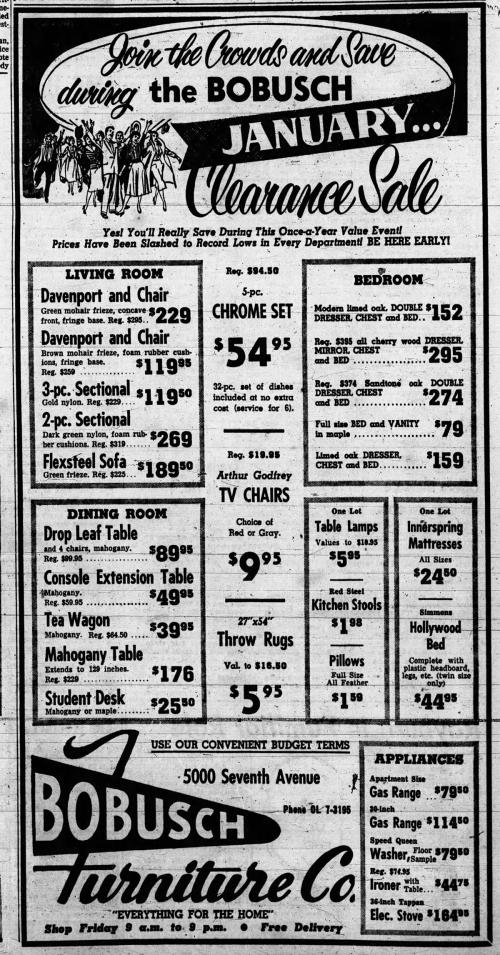
The 90’s
In 1995, the building was purchased by the Lakeshore Business Improvement District (BID) with plans to renovate the building or seek a developer.
In the summer of 1997, the building was purchased by patent designer Robert Venn and his wife, artist Rebecca. Venn paid $20,000 for the building with the promise to spend over $200,000 in the next year to rehabilitate it. While living in North Carolina in the 1980s, the Venns discovered their love of renovation, saving a few of their local homes from the wrecking ball and giving them new life with a complete renovation. By 1992, the couple had relocated to Racine.
As the Venns were preparing for their newest renovation project, a local group showed interest in the space.
Kenosha Institute of Art
Kathleen Ross was the director of the Kenosha Institute of Art which was established in 1993, holding classes around Kenosha but without a real home base.
In October of 1997, just a few months after the Venns purchased the building, it was announced that the Kenosha Institute of Art would take occupancy the following year and renovation was in full swing.
Plans for their new home included six to eight classrooms in the basement, a coffee shop, gift shop, and a library in the mezzanine.
The Kenosha Institute of Art officially kicked off offering classes in March 1999, and for the next several years, workshops were held in the building, but the renovation had stalled. The grand opening date, which had been delayed numerous times, was now on a permanent delay.
Then in August 2003, students arrived to find the doors were locked and the institute was closed.
Students were not reimbursed for their classes, art teachers were not paid for their work, and Wisconsin Electric filed a suit against Ross for nearly $10,000 in unpaid bills. The final straw came when a fire inspection revealed that Ross had not fixed the problems addressed eight months prior.
The Building Lives On
Although the Venns were not involved with the Institute of Art, they were instrumental in the rehabilitation of many parts of the building. One aspect Robert oversaw was the potential of a new, separate business on the western side of the building.
Venn built the entry and private space with a new address, 705 50th Street. Over the next few years, it was home to Marie Plant’s Krafty Finds in 2015. Black Cat Body Works briefly operated there. Then in 2021, Candi Carmody opened Three Moons Acupuncture, where she remained until June 2025. Shortly after, Havenly Arts Studio moved into the space and remains today in 2026.
ArtWorks
Chet Griffith, originally from Gurnee, came to Kenosha in the early 1990s and always had an interest in art. Griffith began Mobile Framing Company in his home. After purchasing the entire stock of a local framing firm, Griffith began thinking about establishing a brick and mortar.
Griffith’s new business, ArtWorks, opened in 2007 and took up three levels of the southern side of the building at the new address of 5002 7th Avenue. A rotating art gallery occupied the upper mezzanine; the main level featured art supplies and Griffith’s framing business, and the basement was reserved for special events.
Over the next several years, ArtWorks held countless events including figure drawing sessions, puppet theater, and more.
In the fall of 2016, Griffith moved ArtWorks to a new storefront at 4513 Sheridan Road to be closer to the newly established Union Park Arts District.
The following year, Security National Mortgage took the space formerly occupied by ArtWorks. But they did not last very long and were soon replaced by Midway Staffing, which occupied this section until 2025.
Rotation of Businesses
In June of 2011, Forever Grateful Consignment Boutique and Art Gallery opened its doors in the main room. Among the antiques, dishware, and furniture, Forever Grateful also featured local and national artists with paintings, photographs, metal art, and jewelry. They closed in 2014.
In 2015, mother and daughter team Shelly Jensen and Kara Shauer stocked shelves with over 9,000 books and opened Thirst Edition. Within four months, Thirst Edition closed up shop.
In March 2018, Iron Horse Winery opened. Unfortunately, they closed by the end of the following year.
Today: Olafson & Porter Vintage Goods
While COVID hit, it wasn’t easy to rent out this space, and the Venns put the building on the market in the early 2020s. A new buyer, Michael Goffman of Pleasant Prairie, came on board in 2024.
Goffman, a self-professed dumpster diver as a kid, worked many years in the construction business before establishing his own business, Recyclean, which specializes in ‘deconstruction’ and saving old materials from the dumpster.
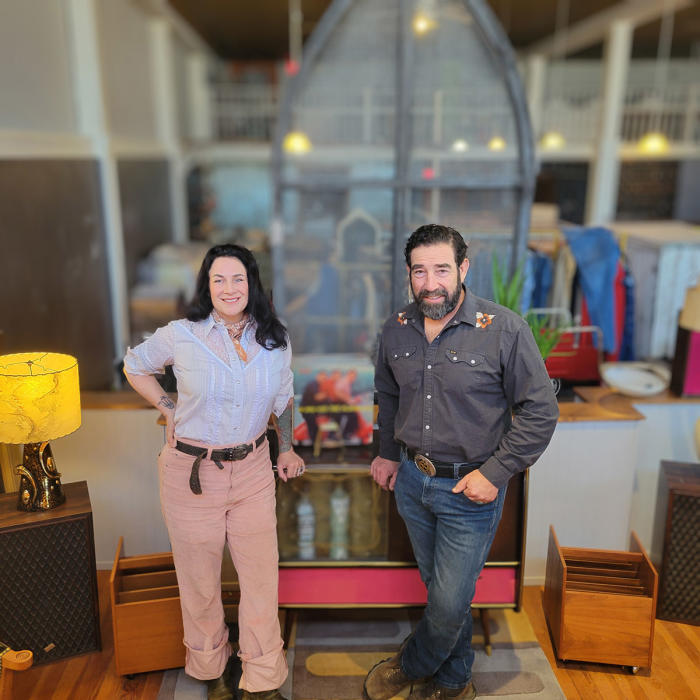
His love for repurposing old building materials led to a partnership with Tamara Zagurski and together they opened Olafson & Porter Vintage Goods in June 2025.